
Book Project
Seize the Schools : Empire, Education and Resistance in Cold War New York and Puerto Rico
Centering empire and Latinx migration in the history of postwar education
Seize the Schools examines connections between education politics in New York City and the colonial Commonwealth of Puerto Rico between 1948 and 1975, considering how both high level policy and grassroots activism were shaped by transnational interactions and a larger Cold War context. It explores, for example, how debates about education’s role in economic development, community control, and bilingual education engaged questions of modernization, sovereignty, and citizenship in conjunction with domestic debates regarding race and postwar American multiculturalism.
By following the movement of policymakers, education researchers, teachers, students, activists, and parents from island to mainland and across the Americas, this study aims to alter the way we frame narratives of postwar urban education. Ultimately, by expanding the geographical reference points for well-known postwar education milestones, such as President Johnson’s Great Society and ESEA reforms, the late 1960s community control debates, and the fight for bilingual-bicultural education, we can gain a better sense of the ideological content of these battles, and better conceptualize the complex relationship between education, empire, and capitalism across the Americas.
Considering the increasing number of Latinx students in the U.S. public school system, and the current movement to decolonize education, it also hopes to uncover thematic parallels between the era under study and our current age.
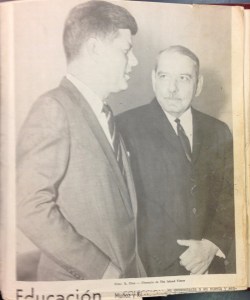
Puerto Rican Governor Luís Muñoz Marín and U.S. President John F. Kennedy on the cover of Educación, a publication of the Departamento de Instrucción Pública of Puerto Rico. Universidad de Puerto Rico, Recinto de Río Piedras, Biblioteca José M. Lázaro, Colección Puertorriqueña y Hemeroteca.

A young girl wearing a “Puerto Rican Power” button receives a free school breakfast from the Young Lords Party of New York. Palante! Tamiment Library and Labor Archives, New York University.
Book Projects
Lauren Lefty and James W. Fraser, eds. Teaching the World’s Teachers (Johns Hopkins University Press, 2019)
Written by education scholars from eleven different countries—Argentina, Brazil, Catalonia-Spain, China, England, Finland, Ghana, Israel, Singapore, South Africa, and the United States—this book provides histories of teacher education reforms between roughly 1980 and 2020. The authors show how international trends that emerged during this period collided with national and regional contexts to produce unique teacher education systems in different nations. While in some countries the embrace of markets and competition led to a deregulation of the teacher preparation field, in others teaching became a highly regulated and centralized affair. At the same time, ideas and structural models cross borders and education leaders borrow from each other while reshaping plans in each place.
Opening with a broad historical overview of global teacher education models beginning in the late eighteenth century, Teaching the World’s Teachers argues that the field has long been characterized by cross-border connections—but shaped by geopolitical hierarchies of power. In an era when teacher quality is widely recognized as one of the most important factors in a child’s education, this volume encourages dialogue among teacher educators and policymakers around the world. By understanding the context and contingency of where we have been, the authors hope that readers will walk away with a more empowered sense of where we are headed in the all-important task of teaching the world’s teachers.
James W. Fraser and Lauren Lefty. Teaching Teachers: Changing Paths and Enduring Debates (Johns Hopkins University Press, 2018)
As recently as 1990, if a person wanted to become a public school teacher in the United States, he or she needed to attend an accredited university education program. Less than three decades later, the variety of routes into teaching is staggering. In Teaching Teachers, education historians James W. Fraser and Lauren Lefty look at these alternative programs through the lens of the past.
Fraser and Lefty explain how, beginning in 1986, an extraordinary range of new teaching programs emerged, most of which moved teacher education out of universities. In some school districts and charter schools, superintendents started their own teacher preparation programs—sometimes in conjunction with universities, sometimes not. Other teacher educators designed blended programs, creating collaboration between university teacher education programs and other parts of the university, linking with school districts and independent providers, and creating a range of novel options.
Fraser and Lefty argue that three factors help explain this dramatic shift in how teachers are trained: an ethos that market forces were the solution to social problems; long-term dissatisfaction with the inadequacies of university-based teacher education; and the frustration of school superintendents with teachers themselves, who can seem both underprepared and too quick to challenge established policy. Surveying which programs are effective and which are not, this book also examines the impact of for-profit teacher training in the classroom. Casting light on the historical and social forces that led to the sea change in the ways American teachers are prepared, Teaching Teachers is a substantial and unbiased history of a controversial topic.
Articles and Book Chapters
— “Puerto Rico Can Teach So Much: The Hemispheric and Imperial Origins of the Educational War on Poverty,” History of Education Quarterly 61:4 (November 2021), 423-448. doi:10.1017/heq.2021.44. Read here.
— “The Question of Independence is Hot Among the Youth Right Now: Puerto Rican Youth Organizing in Postwar New York” in Youth in the Movement: High School Student Activism in Postwar America Since 1945, Dara Walker, Jon Hale, and Alex Hyres, eds. (Austin, TX: University of Texas Press, forthcoming).
— “Bilingual in the Big Apple: Bilingual Education Politics and the Making of New York’s Neoliberal Multiculturalism,” in New York City Since the 1960s (working title), Kim Phillips-Fein, Johanna Fernandez, and Mason Williams, eds., (in progress).
 Lauren Lefty, PhD